Inconsistent UTM names quietly wreck your analytics. These 7 naming rules, a copy-paste formula, and real examples keep every campaign, source, and medium clean and trustworthy.
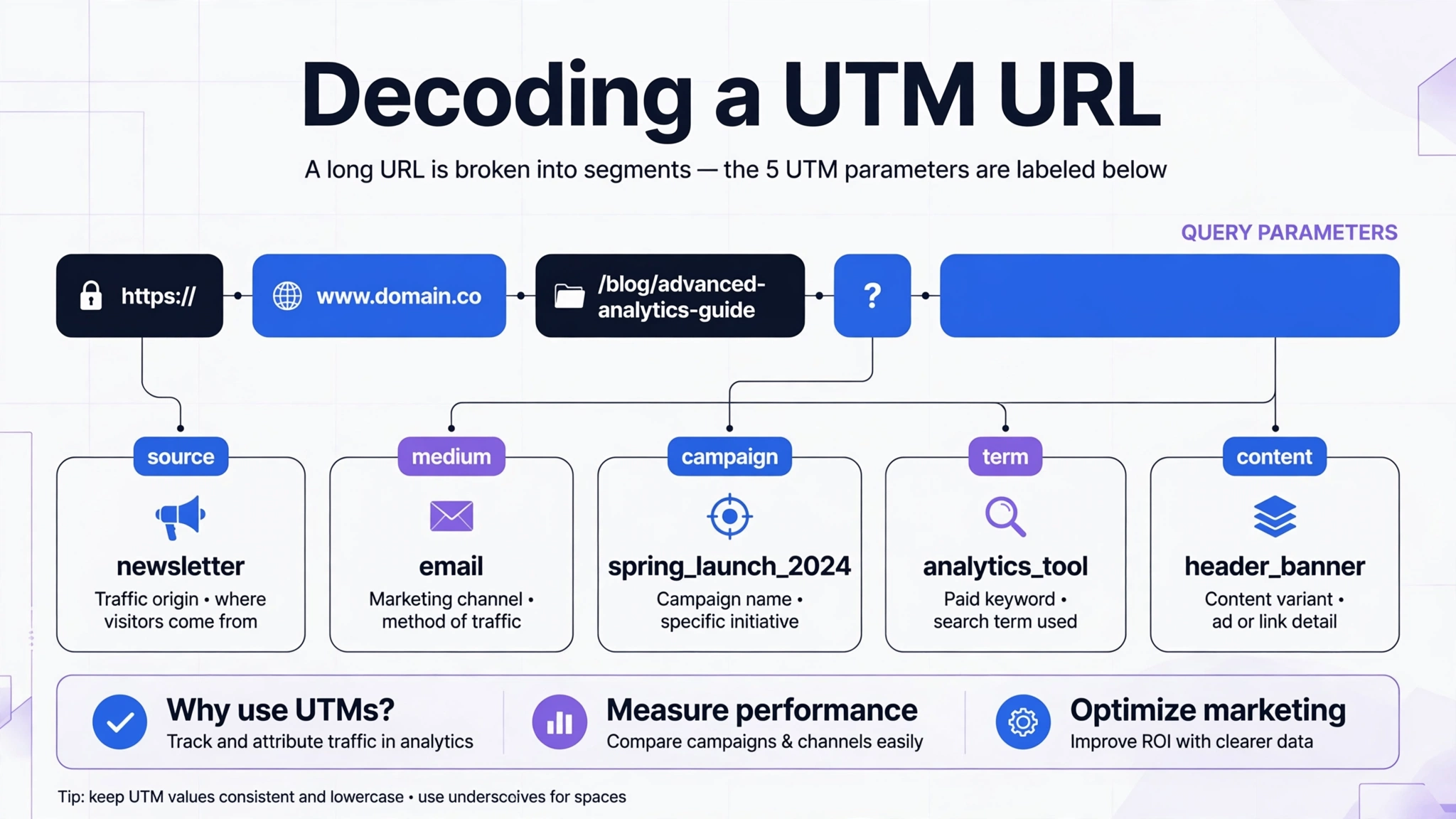
Table of Contents
- What Are UTM Parameters? (A 60-Second Refresher)
- Why Naming Conventions Matter More Than You Think
- The 7 Rules of UTM Naming
- A Copy-Paste Naming Formula for utm_campaign
- utm_source vs. utm_medium: What’s the Difference?
- 6 Mistakes That Wreck UTM Data
- Build Your First Properly Named Link
- Frequently Asked Questions
Key Takeaways
- Always lowercase, no spaces, one separator — this single habit fixes the most common UTM mess.
- utm_source is the “where” (platform); utm_medium is the “how” (channel type). Don’t mix them up.
- Never tag internal links on your own site — it overwrites the visitor’s original traffic source.
- Keep a shared master list of sources/mediums and a running log of every campaign name.
- Use a formula like initiative_audience_date so names stay self-documenting months later.
UTM parameters are the small tags you add to links to track where your traffic comes from. They’re simple — and they’re also where most marketing analytics quietly falls apart. One person writes utm_source=Facebook, another writes utm_source=facebook, a third writes utm_source=FB, and suddenly your “Facebook” traffic is split across three rows in your reports. And if the tags are right but nothing shows up at all, work through the fixes for UTM parameters not showing in GA4.
The fix isn’t a better tool. It’s a naming convention: a small set of rules your whole team follows every time. This guide gives you the 7 rules, a copy-paste naming formula, and real examples — plus a free UTM Builder that formats everything correctly for you.
What Are UTM Parameters? (A 60-Second Refresher)
UTM parameters are five optional tags you append to a URL. Analytics platforms like Google Analytics 4 read them and sort your traffic accordingly:
| Parameter | What it identifies | Example |
|---|---|---|
utm_source |
Where the traffic comes from (the platform) | newsletter, google, instagram |
utm_medium |
How it arrives (the channel type) | email, cpc, social |
utm_campaign |
Which campaign or promotion it belongs to | spring_sale_2026 |
utm_term |
Which keyword triggered it (mainly paid search) | running_shoes_sale |
utm_content |
Which specific link or creative was clicked | header_cta, version_b |
A complete tagged link looks like this:
https://example.com/sale?utm_source=newsletter&utm_medium=email&utm_campaign=spring_sale_2026&utm_content=header_ctaThe first three parameters do 90% of the work. The last two are for finer detail. Everything below is about naming their values consistently.
Why Naming Conventions Matter More Than You Think
Analytics tools treat Facebook, facebook, and FB as three different sources. That’s not a bug — it’s how text matching works. Without conventions, here’s what a typical campaign report looks like after a few months:
Messy (no conventions):
| Campaign | Sessions |
|---|---|
| Spring Sale | 1,204 |
| spring_sale | 847 |
| spring-sale | 198 |
| promo | 96 |
Clean (with conventions):
| Campaign | Sessions |
|---|---|
| spring_sale_2026 | 2,657 |
Same traffic, completely different usefulness. The messy version makes it impossible to answer “how did the spring sale perform?” without manual cleanup in a spreadsheet. The clean version answers it in one glance. Multiply this across sources, mediums, and a year of campaigns, and conventions are the difference between analytics you trust and analytics you ignore.
The 7 Rules of UTM Naming
Rule 1: Always use lowercase
utm_source=facebook — never Facebook, FACEBOOK, or FaceBook. Pick lowercase once and the case-splitting problem disappears forever. This single rule fixes the most common UTM mess.
Rule 2: Never use spaces
Spaces in URLs get encoded as %20 (or +), which is ugly and occasionally breaks tracking when links are copied between tools. Use a separator instead:
- ✅
utm_campaign=spring_sale_2026 - ❌
utm_campaign=spring sale 2026
Rule 3: Pick one separator and stick with it
Underscores (_) or hyphens (-) — both work. What doesn’t work is mixing them (spring_sale-2026 in one link, spring-sale_2026 in another). Choose one for your team and document it.
Rule 4: Be descriptive, not clever
Six months from now, will you know what utm_campaign=promo2 was? Probably not. Descriptive names are self-documenting:
- ✅
utm_campaign=newsletter_welcome_series_feb2026 - ❌
utm_campaign=campaign1
Include enough context — what it is, and when — that future-you can understand it without opening another document.
Rule 5: Don’t repeat information across parameters
Each parameter should add new information. If the source is Instagram, the medium shouldn’t also say Instagram:
- ✅
utm_source=instagram+utm_medium=paid_social - ❌
utm_source=instagram+utm_medium=instagram_ads
Redundancy wastes the medium field, which should describe the channel type (paid social, organic social, email, cpc), not restate the platform.
Rule 6: Agree on a master list of sources and mediums
Don’t let every team member invent source names. Maintain one shared list — a spreadsheet, a Notion page, even a pinned message — of approved values:
Sources: google, facebook, instagram, linkedin, tiktok, newsletter, youtube, referral Mediums: cpc, email, social, organic, display, referral, affiliate
When someone needs a new value, they add it to the list first, then use it. This is the entire “governance” most small teams need.
Rule 7: Keep a log of every campaign name
A simple running list of utm_campaign values — name, date, owner, purpose — prevents two problems: accidentally reusing a name for a different campaign, and forgetting what an old campaign was. Five columns in a spreadsheet is enough.
A Copy-Paste Naming Formula for utm_campaign
Rules tell you what not to do. A formula tells you what to do. Here’s one that works for most teams:
[initiative]_[audience]_[date]Worked examples:
| Campaign | Formula applied |
|---|---|
| Spring sale email to customers | spring_sale_customers_mar2026 |
| Product launch on paid social | launch_prospects_paid_social_may2026 |
| Webinar for existing leads | webinar_leads_apr2026 |
| Black Friday retargeting | black_friday_retargeting_nov2026 |
Adapt the slots to your business — a local business might use [service]_[geo]_[date] (drain_cleaning_austin_jun2026); a blogger might use [post]_[channel]_[date]. The structure matters more than the specific slots: type first, detail second, date last, always in the same order.
Put it together into a full tagged URL:
https://example.com/spring-sale?utm_source=newsletter&utm_medium=email&utm_campaign=spring_sale_customers_mar2026&utm_content=hero_buttonutm_source vs. utm_medium: What’s the Difference?
This is the most confused distinction in UTM tagging, so let’s settle it:
utm_source= where. The specific platform or sender. Which newsletter? Which network? →newsletter,google,instagram,facebook.utm_medium= how. The type of channel or traffic. →email,cpc,social,organic,referral.
Paired examples:
| Scenario | utm_source | utm_medium |
|---|---|---|
| Link in your monthly newsletter | newsletter |
email |
| Google Ads campaign | google |
cpc |
| Organic Instagram post | instagram |
social |
| Paid Facebook campaign | facebook |
paid_social |
| Guest post on another blog | partner_blog_name |
referral |
Memory aid: source is the “where,” medium is the “how.” If you can only remember one thing from this guide, remember that sentence.
6 Mistakes That Wreck UTM Data
1. Tagging internal links on your own site
UTM parameters on links within your own website overwrite the original traffic source in analytics. Your homepage banner linking to /sale with UTM tags will make GA4 think that visitor “came from” your homepage banner instead of Google. Only tag links pointing to your site from outside.
2. Using a different case for the same source
Email vs email vs EMAIL — three rows, one channel. (See Rule 1. It’s worth repeating because it’s the #1 real-world offense.)
3. Spaces and special characters
utm_campaign=summer sale! becomes summer%20sale%21 in the URL. It usually still tracks, but your reports look terrible and some email tools mangle it. Letters, numbers, underscores, hyphens — that’s the whole allowed alphabet.
4. The “campaign1” problem
Generic names (promo, test, campaign_final_v2_REAL) are unactionable the moment you have more than a handful of campaigns. Descriptive names cost five extra seconds and save hours of detective work.
5. Inconsistent date formats
spring2026, spring_2026, 2026_spring, mar26 — pick one date style (mar2026) and use it everywhere, including inside campaign names.
6. Never auditing old tags
Once a quarter, export your campaign/source/medium values and scan for duplicates, typos, and near-misses (facebok, newletter). Fifteen minutes of cleanup keeps the system trustworthy.
Build Your First Properly Named Link
Theory is nice; let’s make it concrete. Here’s the workflow:
- Decide the three core values using your formula: source (where), medium (how), campaign (initiative_audience_date).
- Add content/term only if useful —
utm_contentfor distinguishing two links in the same email (e.g.,hero_buttonvs.footer_link);utm_termfor paid-search keywords. - Build the URL with our free UTM Builder: paste your page URL, fill in the values, and it assembles and encodes the final link. No manual
?and&wrangling, no encoding mistakes. - Test it before publishing: open the link, confirm the page loads, and check that your analytics shows the visit under the right source/medium/campaign, as shown in how to find UTM campaign data.
- Log the campaign name in your shared list (Rule 7).
Do this five times and the convention becomes habit. Do it as a team and your analytics becomes something you can actually make decisions from.
Frequently Asked Questions
Do UTM parameters affect SEO?
No. Search engines ignore UTM parameters for ranking purposes, and tagged URLs shared externally don’t create duplicate-content problems in practice (Google is good at consolidating URL variants). The one caveat: don’t use UTM-tagged URLs as your canonical links or in your sitemap — keep those clean.
Should UTM values be uppercase or lowercase?
Lowercase, always. Analytics platforms treat values as case-sensitive text, so Email and email become separate rows. Lowercase-only is the simplest rule with the biggest payoff.
Should I use UTM tags on internal links within my own site?
No. Tagging your own internal links overwrites the visitor’s original source in your analytics (a phenomenon sometimes called “source hijacking”). Use UTM tags only on links that bring people to your site from outside.
Hyphens or underscores — which separator should I use?
Either works technically. Underscores are slightly more common in UTM values; hyphens are more common in URLs generally. What matters is picking one and using it consistently across every campaign.
How many UTM parameters should I use?
Three (utm_source, utm_medium, utm_campaign) cover the vast majority of needs. Add utm_content when you’re testing multiple links or creatives in the same campaign, and utm_term for paid-search keyword tracking. More parameters than you analyze is just noise.
Build clean UTM links in seconds
Put the naming system into practice: paste your link into our free UTM Builder and get a properly encoded, convention-clean tracking URL instantly.