Prices checked November 2026 on official vendor pages. No sponsored listings — rankings on merit. How we review: https://smartrisehq.com/how-we-review-ai-tools/
60-second pick: Making things? Claude Pro. Finding things? Perplexity Pro.
Research-based: no hands-on testing is claimed for these tools.
HEAD-TO-HEAD COMPARISON
Claude vs Perplexity is not really a fight over “which AI is smarter” — it is a fight over where your day happens. Claude is a reasoning workhorse for writing, coding, and long documents; Perplexity is an answer engine for live research with citations. The short answer — pay for Claude Pro if your day is drafting and building; pay for Perplexity Pro if your day is researching and verifying. And most people should start on both free tiers, because the limit math is more generous than it looks.
Updated November 2026 · Editorial comparison
THE REASONING WORKHORSE
Claude at a Glance
Anthropic
BEST FOR
Deep thinking, long-form writing, and coding with agentic tools like Claude Code — plus real web search now included on every plan.
THE ANSWER ENGINE
Perplexity at a Glance
Perplexity AI
BEST FOR
Researching anything with inline citations you can click — fast answers from the live web, deep reports, and model choice on paid plans.
Verdict · Features · Pricing · FAQ
The honest difference in one paragraph
Claude is where you do work: drafting an essay, refactoring code, reasoning through a messy problem, or working through a 200-page document. Perplexity is where you find out things: what happened today, which laptop to buy, what a study actually concluded — every answer carrying numbered citations back to live sources. They overlap (both now search the web; Claude has a research mode, Perplexity has writing help), but the defaults are opposite: Claude defaults to thinking, Perplexity defaults to searching. Pick the one that matches what you do most, or — the angle most comparisons skip — start free on both and only pay once the limits actually bite.
Trust & data use: what the vendors actually say
Only published vendor commitments are listed here. Training defaults for consumer tiers change and were not confirmed on official pages at research time, so we do not claim them as fact.
| TOPIC | Claude (Anthropic) | Perplexity |
|---|---|---|
| ENTERPRISE DATA CONTROLS | Enterprise tier offers custom data retention, audit logs, Compliance API, role-based access, IP allowlisting, and a HIPAA-ready offering. From Anthropic’s official pricing/FAQ pages. |
Enterprise Pro includes SSO, admin controls, internal search/connectors, and states that data is not used for training. Checked on Perplexity’s official pricing page, October 2026. |
| CONSUMER TRAINING DEFAULTS | Not confirmed from official pages at research time — both vendors’ consumer data-use defaults are published in their privacy policies and can change. Read the current policy before trusting it either way. | |
Claude in Detail
Claude is Anthropic’s AI assistant — a chat interface on web, desktop, and mobile, backed by serious agentic tooling. Claude Code, included in all paid plans, runs in your terminal, IDE, or desktop and shares your plan’s usage limits. Projects give you persistent workspaces with files and custom instructions, and Artifacts turn outputs into shareable documents, slides, and designs. Memory carries context across conversations, connectors hook into apps like Slack, Gmail, and Microsoft 365, and web search is now available on all plans, including Free.
The model ladder behind the plans is published on Anthropic’s platform pages: Fable 5.1 (next-gen agent model), Opus 5.5 (daily driver for agentic coding), Sonnet 5.5 (the speed/intelligence balance), and Haiku 5.5 (fastest, most cost-effective) — all with a 1-million-token context window. What subscriptions buy is not the models themselves but usage multipliers: Pro gets at least 5x more usage per five-hour session than Free, and Max gets 5x more than Pro, with weekly limits layered on top of the rolling five-hour window.
Visit Claude’s official site →
Perplexity in Detail
Perplexity is an answer engine. You ask a question; it searches the live web and writes a short answer with inline numbered citations you can click through. That is its whole identity — it is the fastest honest way to go from question to sourced answer. Research mode runs many searches and reads many sources before writing a longer report. Focus modes (Web, Academic, Social, Finance) narrow where it looks, Spaces organize ongoing research topics, and the Discover page serves live headlines.
Two things surprise most people. First, Perplexity’s paid plans let you choose the underlying model — options span OpenAI’s GPT models, Anthropic’s Claude Sonnet, Google’s Gemini, and Perplexity’s own Sonar, so a paid Perplexity plan can literally run a Claude model under the hood. Second, the Comet browser is free for everyone, and Perplexity Computer — an agentic mode on Pro and Max — spends credits to do multi-step work for you.
Visit Perplexity’s official site →
Our Verdict
An honest editorial take — not sponsored, not influenced by affiliate relationships.
OUR VERDICT
Editorial opinion based on publicly available information.
If you pay for one $20 subscription: pick Claude Pro for making things, Perplexity Pro for finding things. Claude Pro pays for itself first for anyone who writes, codes, or works through long documents daily — Claude Code, Projects, and 5x the usage of Free turn a $20 month into real output. Perplexity Pro pays for itself first for anyone who researches daily — model choice, Research mode, and Computer credits make it a research desk, not a search box. If your usage is light, stay free on both: Claude Free handles everyday questions and Perplexity Free handles quick research, and the free limits are the real budget sweet spot most comparisons ignore.
Choose Claude if your day is writing, coding, or deep reasoning through long documents — and if you want agentic coding (Claude Code) included in the subscription.
Choose Perplexity if your day is researching current events, products, papers, or prices — and you want every answer carrying clickable citations, with the option to run Claude or GPT models inside it.
Why the verdict holds
The deciding factor is not benchmark scores — it is what you do with the answer. Claude’s strengths compound: memory across conversations, Projects with persistent files, and Claude Code mean a subscription becomes a workbench. Perplexity’s strengths compress: a question becomes a cited answer in seconds, and Research mode replaces a morning of tab-hopping. Most people do both kinds of work, which is why “$40 for both” is the lazy default. The honest math: Claude Pro’s 5x-over-Free usage allowance covers heavy daily writing or coding; Perplexity Free’s basic searches are practically unlimited, so many people can run Perplexity Free for lookup + Claude Pro for work — or the reverse if their day is research-first. And students and educators have a third option: Perplexity’s $10/month Education tier (SheerID-verified) puts Pro features at half price.
Who should pick which
- Writers & students drafting: Claude Pro — long-form quality, Projects, memory.
- Developers: Claude Pro — Claude Code in terminal/IDE with plan usage included.
- Researchers, journalists, analysts: Perplexity Pro — citations, Research mode, Academic focus.
- Casual users (a few questions a day): Free on both — the limits will not bite.
- Teams & regulated industries: compare Team/Enterprise tiers on the official pages — Claude’s Enterprise lists custom retention and HIPAA readiness; Perplexity’s Enterprise Pro states training exclusion.
Feature Snapshot
Side-by-side facts drawn from publicly available product information.
| FEATURE | Claude | Perplexity |
|---|---|---|
| CORE JOB | Reasoning workhorse: chat, writing, coding, long documents Claude Code included in all paid plans. |
Answer engine: live web research with clickable citations Research mode, Focus modes, Spaces, Discover page. |
| MODEL LINEUP | Fable 5.1, Opus 5.5, Sonnet 5.5, Haiku 5.5 (1M context) Anthropic-only models; subscriptions buy usage multipliers, not the models themselves. |
Choice of 8+ models on Pro: GPT, Claude Sonnet, Gemini, Sonar Free uses basic models with automatic selection. |
| WEB SEARCH | Yes — on ALL plans including Free Confirmed on Anthropic’s official pricing page. |
Yes — it is the product; inline numbered citations Practically unlimited basic searches on Free. |
| AGENTIC CODING | Claude Code — terminal, IDE, desktop; included in paid plans Shares the plan’s usage limits. |
Perplexity Computer — credit-based agentic mode (Pro/Max) Pro includes 4,000 bonus credits (official pricing page). |
| WORKSPACES | Projects (paid plans): files + persistent instructions; Memory; Connectors (Slack, Gmail, Microsoft 365) | Spaces for research topics; Labs; built-in slides/sheets/docs (paid) |
| API ACCESS | Anthropic API (pay-per-token); Max/Team include API credits Max: $100–$200/mo API credits; Team: per-seat credits, pooled. |
Sonar API (usage-based); Pro includes $5/mo credits Corroborated; confirm on the official page. |
| MOBILE + DESKTOP APPS | Web, desktop, mobile chat apps | Web, mobile apps, Comet browser (free for everyone) |
Pricing & Free Options
Plans change often — always confirm on the official site before buying. Claude prices verified on Anthropic’s official pricing page, October 2026. Perplexity prices were checked on Perplexity’s official pricing page (perplexity.ai/hub/pricing) in November 2026.
Claude
FREE TIER · PAID PLANS
Freemium
Prices from claude.com/pricing (checked 24 October 2026), excluding tax
✓ Free ($0): chat on web/desktop/mobile, web search, files, code execution, memory, connectors, Artifacts — with everyday limits on a rolling 5-hour window
✓ Pro ($20/mo, or $17/mo billed annually — $200 up front): at least 5x Free’s usage per 5-hour session, Claude Code, Projects, more models, scheduled tasks, Claude in Chrome and Microsoft 365
✓ Max (from $100/mo, monthly only): 5x Pro’s usage per 5-hour session, higher output limits, priority access, $100–$200/mo API credits
✓ Team (2–150 seats): Standard and Premium tiers with usage multipliers, shared workspaces, SSO, central billing — check the official page for current per-seat pricing
✓ Enterprise ($20/seat/mo, annual + API-rate usage): Team features plus audit logs, Compliance API, custom retention, HIPAA-ready offering
− Paid plans add weekly limits and optional prepaid usage credits once session limits are hit.
Perplexity
FREE TIER · PAID PLANS
Freemium
Figures checked against Perplexity’s official pricing page (perplexity.ai/hub/pricing), October 2026
✓ Free ($0): practically unlimited basic searches, a few Pro searches per day, limited file uploads, basic models with automatic selection
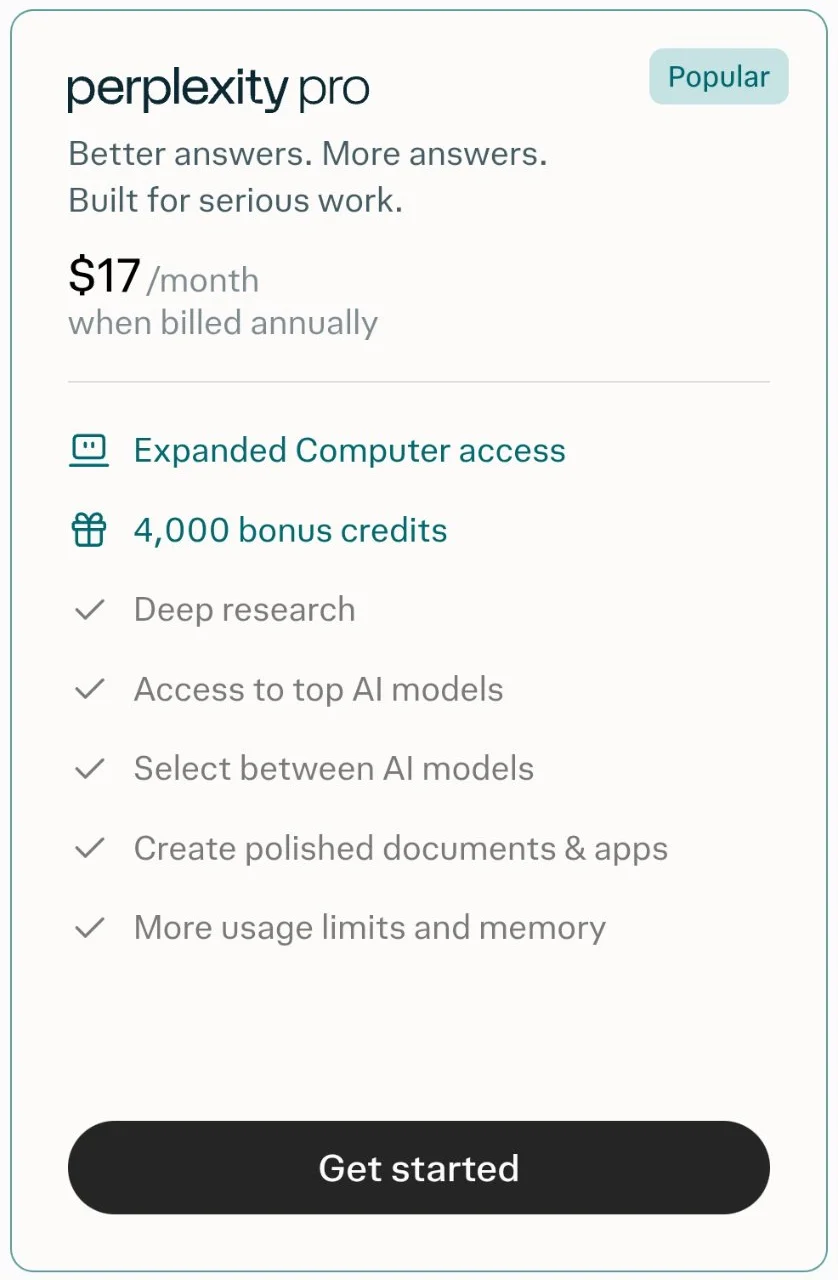
✓ Pro ($20/mo, or $17/mo billed annually — $200 up front): much more Pro Search and Deep Research, 8+ model choice (GPT, Claude Sonnet, Gemini, Sonar), Labs, image/video generation, Perplexity Computer + bonus credits, $5/mo Sonar API credits
✓ Education Pro ($10/mo, SheerID-verified students/educators): everything in Pro plus study tools
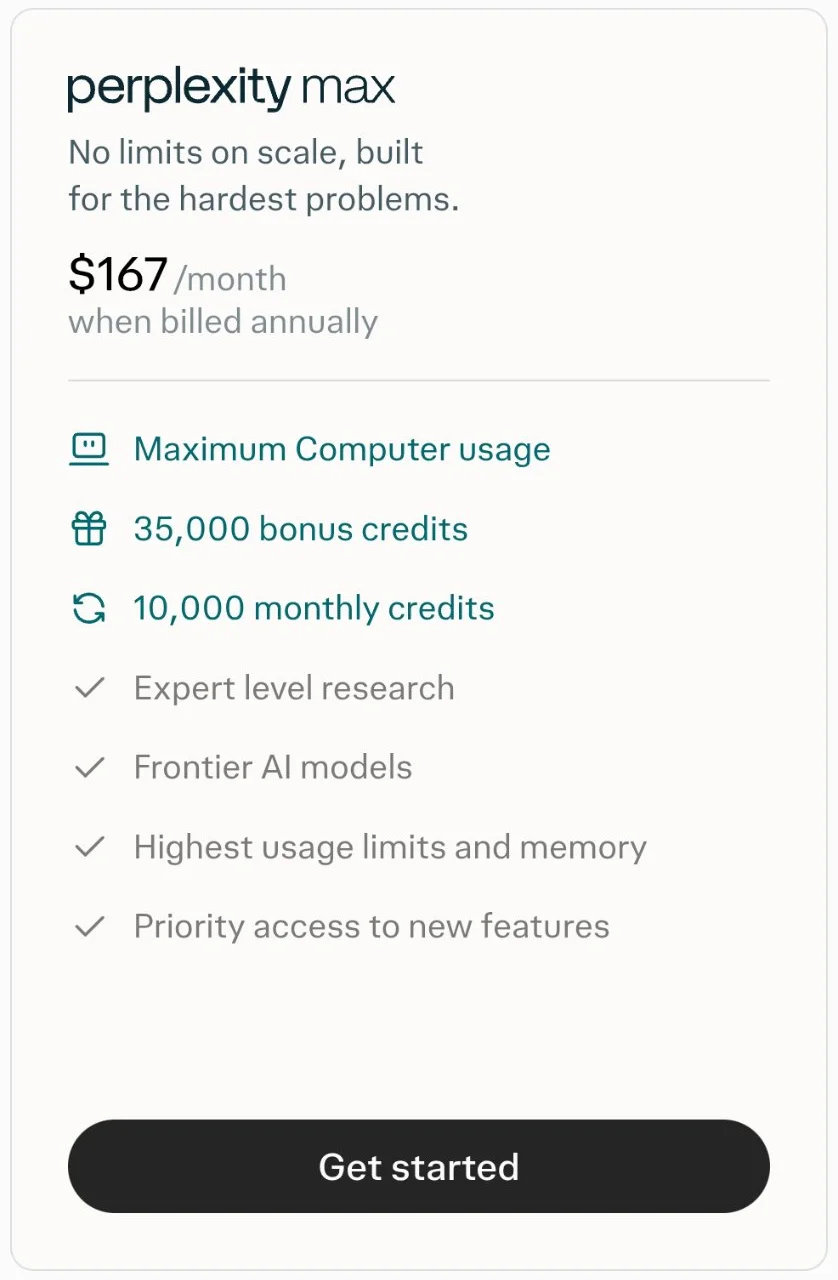
✓ Max ($200/mo, or $167/mo billed annually): highest Research/Computer limits, frontier models, Model Council, Comet Max Assistant, priority support
✓ Enterprise (from $40/seat/mo): SSO, admin controls, internal search/connectors, training exclusion
− Free-tier Pro-search and Research allowances differ across sources — treat the exact counts as moving targets.
Free-tier ceilings: the limit math most reviews skip
This is the part that decides the budget question — because the right answer for most people is to pay nothing until a limit actually bites.
Claude Free is built for everyday questions: chat everywhere, web search, files, code runs, and memory are all included, with usage resetting on a rolling five-hour window. The ceiling shows up when you hit the window mid-flow — the smaller everyday allowance is fine for a few questions a day, but a full day of drafting or debugging will need Pro’s at-least-5x allowance. Claude Code, Projects, and the heavier model access are paid-only features, so developers hit the free ceiling fastest.
Perplexity Free is built for quick research: basic searches are practically unlimited, which covers most “what is / who won / how much” questions completely free. The ceiling is the Pro searches — the deeper, multi-source answers and Research reports — of which Free gets only a few per day, plus limited file uploads. If your research needs run deeper than a few serious questions a day, that is the exact point Pro earns its $20.
The bottom line on limits: if you ask a handful of questions a day, both free tiers cover you indefinitely. Upgrade when you repeatedly run out — not on day one.
Using both together: the concrete handoff
Nearly every comparison says “use both” and stops there. Here is the actual workflow, with example prompts, for a research-and-draft task like writing a market overview:
- Perplexity gathers the evidence. Ask: “Find the five most recent analyst reports on [topic] with publication dates, and quote the three key figures from each.” The citations are the point — you now have sources, not just claims.
- Claude synthesizes and drafts. Paste the Perplexity summary (or its report) into a Claude Project and ask: “You are an editor. Using only the sourced material below, draft a 1,200-word overview with three sections, flag any claim that lacks a citation, and suggest where the argument is weakest.”
- Perplexity verifies the draft. Feed disputed claims back: “Check whether [claim] is supported by at least two independent sources published in 2026, with links.”
This handoff plays to each tool’s default — Perplexity searches, Claude thinks — instead of asking either to do the other’s job. If you already pay for one, the free tier of the other completes the pair.
Strengths & Trade-offs
Our editorial assessment of where each tool shines — and where it doesn’t.
Claude
THE REASONING WORKHORSE
Perplexity
THE ANSWER ENGINE
Bottom Line
Claude and Perplexity are complements with one real overlap: everyday AI questions. The one-subscription answer: buy Claude Pro if you make things with AI (writing, code, analysis); buy Perplexity Pro if you find things with AI (research, news, verification with citations). Run the free tier of the other as your second tool — the combined workflow above shows how they complete each other. And if your usage is light, pay neither: both free tiers are genuinely usable, which is the budget answer most comparisons are afraid to print.
Get better answers from either tool
Give Claude the material, not just the question — paste your notes or sources and ask it to flag weak claims. Give Perplexity a time frame and a focus — “sources from 2026” and Academic focus beat vague queries every time. And verify any answer you will act on: click the citations on Perplexity, and cross-check Claude’s synthesis back in Perplexity before publishing.
Frequently Asked Questions
Which is better: Claude or Perplexity?
It depends on the job. Claude is better for writing, coding, and reasoning through long documents. Perplexity is better for researching current information with citations you can verify. For everyday questions both work, and both have free tiers worth trying first.
How much does Claude Pro cost in 2026?
Claude Pro is $20/month billed monthly, or $17/month billed annually ($200 up front), per Anthropic’s official pricing page (checked October 2026). Max starts at $100/month (monthly billing only). Prices exclude tax and change over time — confirm on claude.com/pricing before buying.
Is Perplexity Pro worth it?
For daily researchers, usually yes: much more Pro Search and Deep Research, model choice across providers (including Claude Sonnet), and Perplexity Computer credits. For occasional lookups, the Free tier — with practically unlimited basic searches — is enough. Students and educators get Education Pro at $10/month.
Can I use a Claude model inside Perplexity?
Yes — Perplexity’s paid plans let you choose the underlying model from several providers, and its help center lists Claude Sonnet among the selectable options. That makes Perplexity Pro one way to get Claude-family reasoning with Perplexity’s citation-first research on top.
Which is better for coding, Claude or Perplexity?
Claude, by a wide margin: Claude Code is included in all paid plans and works in the terminal, IDE, and desktop with the plan’s usage limits. Perplexity has no native coding agent; it answers coding questions, but it does not work inside your codebase.
Can I use Claude and Perplexity together?
Yes — and that is the recommended setup. Use Perplexity to gather and cite current evidence, then Claude to synthesize and draft from it, then Perplexity again to verify disputed claims. The free tier of one plus a paid subscription to the other covers most workflows.
Keep comparing
- Claude vs Gemini — how Claude stacks up against Google’s assistant.
- ChatGPT vs Claude — the two heavyweights for writing and reasoning, head to head.
- ChatGPT vs Gemini — ChatGPT against Google’s assistant.
- ChatGPT vs GitHub Copilot — ChatGPT and GitHub Copilot compared head-to-head on features and price.
How we compare
Both assistants are evaluated against the same criteria — capabilities, ease of use, pricing and value, and limitations — using official documentation, pricing pages, and published product information. All pricing figures are read from the vendors’ official pricing pages; where a figure could not be read directly, it is labeled as corroborated rather than verified, and readers are pointed to the official page to confirm. If we test a tool ourselves in the future, the review will say so and include our screenshots, test tasks, and observations. This verdict is editorial opinion based on publicly available information, not sponsored, and not influenced by affiliate relationships. SmartRiseHQ currently uses no affiliate or referral links.
A note on pricing
AI assistant pricing and plan limits change frequently — model access, usage caps, and trial terms all move. Claude prices above were verified on the official pricing page in November 2026; Perplexity figures were checked on Perplexity’s official pricing page (perplexity.ai/hub/pricing) in November 2026 — always confirm current plans on the vendor’s official pricing page before buying.